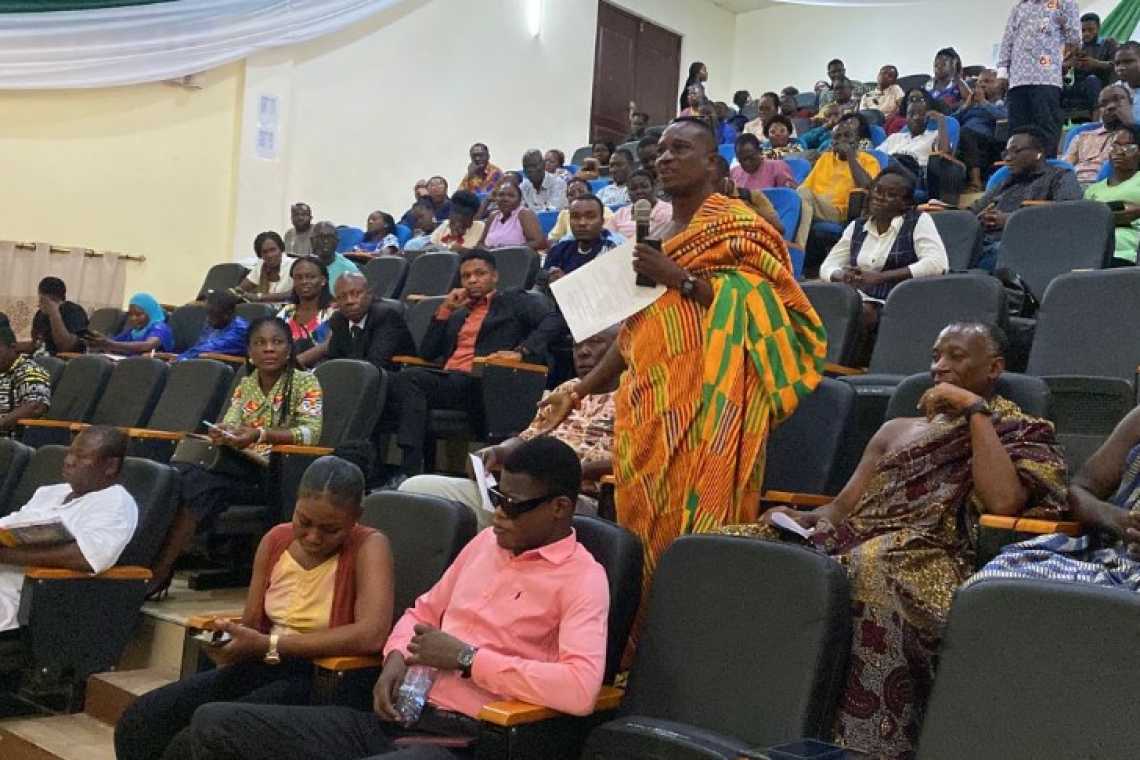
Cape Coast, Saturday, February 21, 2026 Marking International Mother Language Day, Professor Clement Kwamena Appah, Principal of the Accra City Campus of the
University of Ghana (UG), has made a passionate plea for the state to fund a "National Terminology Programme."
Speaking at a workshop organized by the University of Cape Coast (UCC), Prof. Appah argued that for Ghana to truly "decolonize" its education system, it must move beyond traditional speech and develop standardized, technical vocabularies for its indigenous languages. This, he asserts, is the only way to ensure "linguistic sovereignty" for the millions of Ghanaians who do not speak English.
1. The Core Argument: Decolonizing the Mind
Prof. Appah emphasized that the current dependence on English for teaching complex scientific and mathematical concepts creates an intellectual barrier.
-
The Participation Gap: Teachers and students who are more fluent in their mother tongues are often excluded from global knowledge creation because they lack the technical vocabulary to express complex thoughts in those languages.
-
The Goal: By standardizing terminologies in languages like Twi, Ga, Ewe, and Dagbani, Ghana can demystify academic concepts, making them accessible to the broader population.
2. Proposed Structural Reforms
The workshop, themed "Terminology Development in the Ghanaian Language," brought together stakeholders from 21 colleges of education and various universities. Prof. Appah proposed a three-pronged approach to funding and implementation:
| Proposal | Primary Stakeholder | Goal |
| National Terminology Register | Government of Ghana | To streamline and archive all newly developed words to prevent contradictions. |
| Direct Funding | GTEC, GetFund, & National Research Fund | To provide grants for linguistic research and field-testing of new vocabularies. |
| Standardization Council | Linguistic Association of Ghana | A central body to verify and approve new terminologies for use in textbooks. |
3. The Digital Dimension: AI and Ghanaian Languages
The call for terminology development comes at a critical time. Earlier this year (January 2026), Education Minister Haruna Iddrisu announced a partnership with Google to integrate 12 approved Ghanaian languages into AI-driven education tools.
Experts at the UCC lecture, including Dr. Vincent Erskine Aziaku, noted that without standardized terminology, these AI tools—including speech recognition and translation—will struggle to be accurate, further highlighting the urgency of Prof. Appah’s proposal.
4. International Mother Language Day 2026
This year’s global theme, "Youth Voices on Multilingual Education," resonates deeply with the Ghanaian context. UNESCO’s Director-General, Prof. Khaled El-Enany, noted in his message today that "no voice should be missing from the story of our humanity," a sentiment echoed by Ghanaian educators who believe mother-tongue education is a fundamental human right.
The Bottom Line
Prof. Appah’s call is a reminder that language is more than a cultural artifact; it is an economic and educational tool. For the 24-Hour Economy and the "Big Push" infrastructure projects to succeed, technical knowledge must reach every Ghanaian in the language they understand best.