
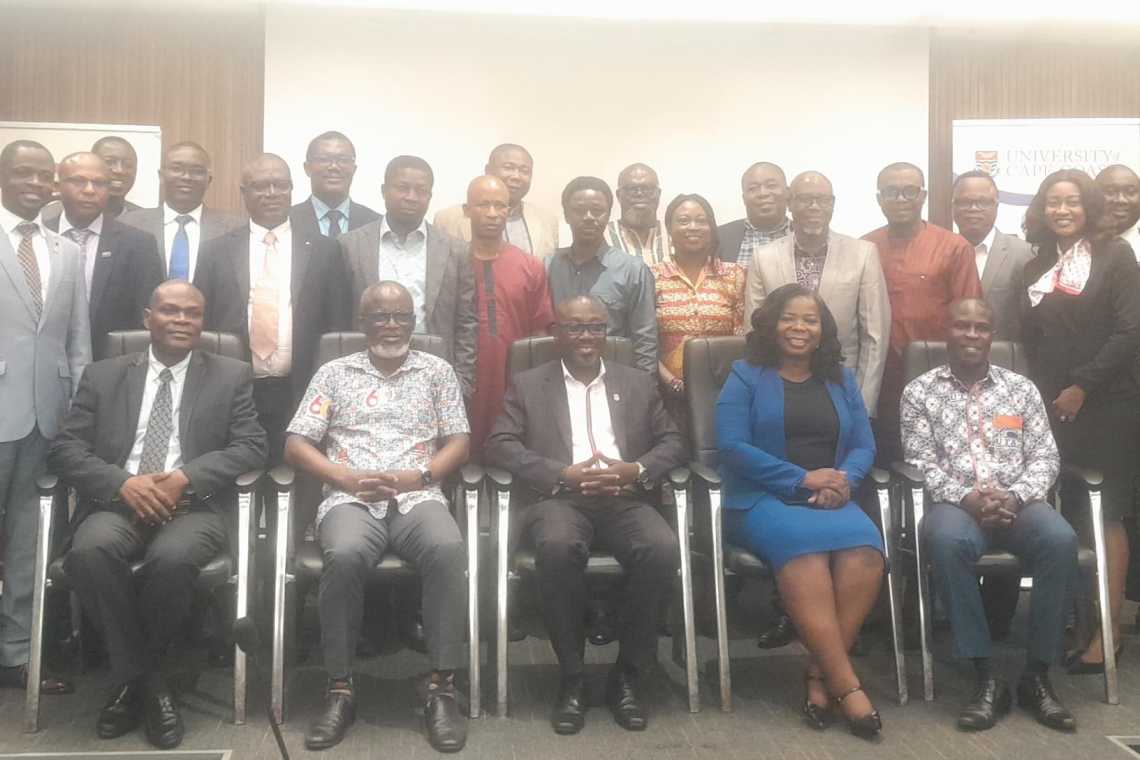
The University of Cape Coast (UCC) has officially launched the Africa Ocean Institute (AOI), a specialized center dedicated to advancing ocean and coastal research. The institute is designed to address the
critical environmental and socio-economic challenges facing Africa’s marine spaces, from overfishing to climate-induced habitat degradation.
Announcing the launch on Tuesday, February 10, 2026, the Acting Vice-Chancellor, Professor Denis Worlanyo Aheto, confirmed that the university has secured all necessary approvals from the Ghana Tertiary Education Commission (GTEC) to begin full operations.
A Multidisciplinary Structural Model
The AOI is not starting from zero; it is an integration of three existing, high-performing UCC units:
-
Centre for Coastal Management (CCM): A World Bank-designated Africa Centre of Excellence.
-
Department of Fisheries and Aquatic Sciences (DFAS): Ghana's leading academic department for marine biology.
-
Centre for Marine Affairs (CeMA): A hub for ocean governance and maritime policy.
Core Strategic Interventions
The Institute aims to bridge the gap between "science and policy" through four main pillars:
-
Applied Research: Focusing on blue economy growth, biodiversity conservation, and marine pollution.
-
Policy Support: Providing the Ghanaian government and African regional bodies with evidence-based data for maritime spatial planning.
-
Capacity Development: Specialized training for a new generation of African ocean professionals and researchers.
-
Community Outreach: Documenting indigenous marine knowledge and enhancing the resilience of local fisherfolk.
The Global and Economic Stake
Professor Joseph Aggrey-Fynn, Head of DFAS, noted that Ghana’s marine potential remains largely untapped. He cited emerging opportunities in wave energy, pharmaceutical research from marine organisms, and high-value eco-tourism.
To support this ambitious vision, UCC has already leveraged over $500,000 in grants and partnerships over the last six years, building a robust international network that includes the World Bank, USAID, and the UK's Blue Planet Fund.
| Thematic Priority | Goal |
| Food Security | Strengthening evidence-based fisheries management. |
| Climate Resilience | Supporting coastal communities in adapting to rising sea levels. |
| Biodiversity | Conserving endangered marine habitats and species. |
| Ocean Governance | Rebranding Africa as a leader in international ocean processes. |
The Bottom Line
The Africa Ocean Institute marks UCC’s evolution from a local educational leader to a continental authority on SDG 14 (Life Below Water). By integrating CCM’s research power with CeMA’s policy focus, the AOI is positioned to be the primary engine for Africa’s sustainable blue economy by the end of this decade.