
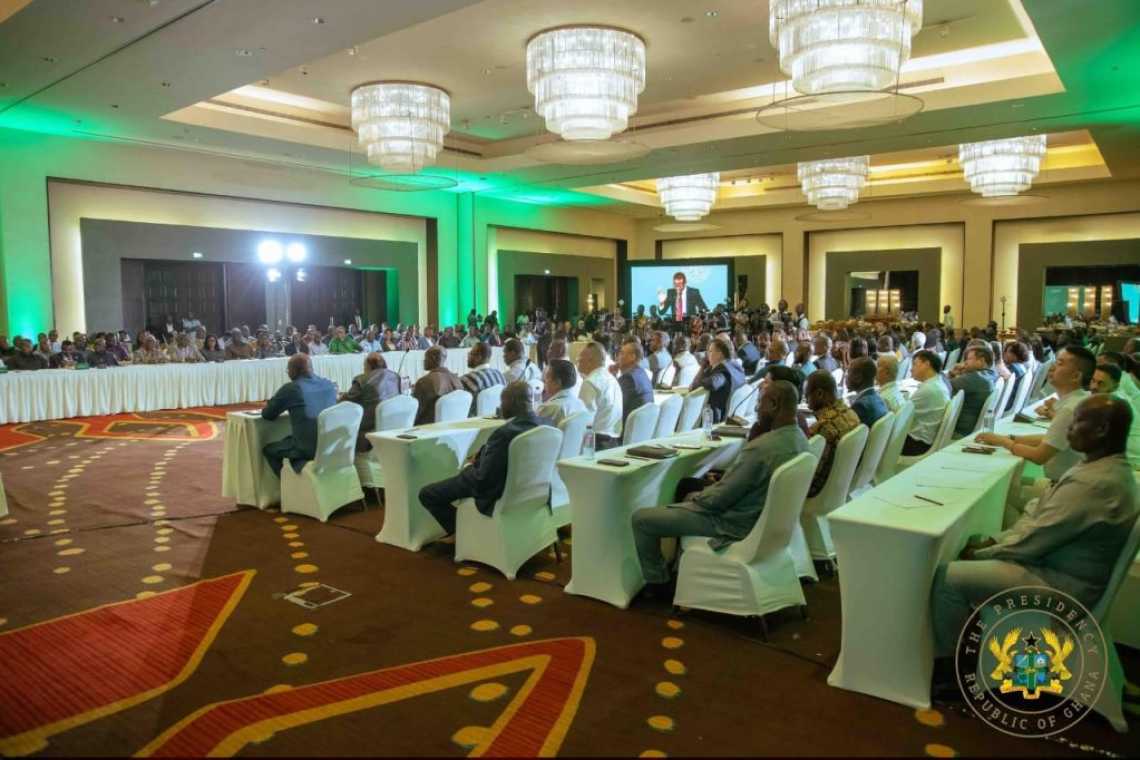
In a major policy expansion during his Presidential Dialogue with the Private Sector, President John Dramani Mahama has announced a sweeping overhaul of Ghana’s agricultural
and industrial sectors. At the heart of this "productivity revolution" are two critical pillars: the imminent National Agribusiness Policy and the newly established 24-Hour Economy Authority.
The President signaled that the era of Ghana being a "raw commodity exporter" is ending, as the government moves to insulate the economy from the "wild fluctuations" of international markets, particularly in the cocoa sector.
1. Cocoa Sector Reform: The "70% Guarantee"
Acknowledging the recent "painful" downward review of domestic producer prices due to global market instability, the President outlined a radical restructuring of the cocoa value chain.
-
Automatic Price Mechanism: Farmers will now be guaranteed 70% of the international market price, adjusted at prevailing exchange rates.
-
Domestic Funding: Moving away from heavy reliance on foreign syndication by introducing domestic funding for cocoa purchasing.
-
Revamping PBC: A strategic effort to revitalize the Produce Buying Company (PBC) and expand the involvement of local licensed buying companies.
-
COCOBOD "Lean" Operations: A drastic reduction in expenditure and the total elimination of waste within the Ghana Cocoa Board.
2. The 24-Hour Economy Authority: Now Law
President Mahama confirmed he has assented to the 24-Hour Economy Bill, officially enacting it into law and establishing the 24-Hour Economy Authority. This body will coordinate the transition of Ghana’s industrial sector from a single-shift model to a three-shift powerhouse.
Incentives for 24-Hour Manufacturers:
-
Energy: Off-peak electricity tariffs to lower nighttime operational costs.
-
Taxation: Duty exemptions on equipment imported for factory expansion.
-
Logistics: Enhanced nighttime security and structured labor dialogues to manage shift transitions.
"Factories operating one shift produce one shift output. Factories operating three shifts maximize capital, infrastructure, and labor productivity. This is not mere reform; it is a productivity revolution." — President John Dramani Mahama
3. Agribusiness and Value Addition
The upcoming National Agribusiness Policy will serve as the anchor for the government's value-addition goals. The President set a bold timeline for the extractive sector as well:
-
Mineral Oils: A target to achieve 100% local processing of all mineral oils within a five-year timeframe.
-
Tree Crops: Expanding processing capacity for cocoa and other tree crops to ensure Ghana captures more of the global value chain.
4. Ghana as West Africa’s "Production Hub"
The President framed these domestic reforms as a direct strategy to win under the African Continental Free Trade Area (AfCFTA). He argued that simply having access to the world’s largest integrated market is not enough—Ghana must be competitive.
The Bottom Line
The 2026 "Reset" has moved from stabilization to structural transformation. By legislating the 24-Hour Economy and guaranteeing farmers a fair share of international prices, the government is attempting to build a resilient, production-led economy. The focus is now on the 24-Hour Economy Authority to prove that Ghana can indeed work while the rest of the region sleeps.