
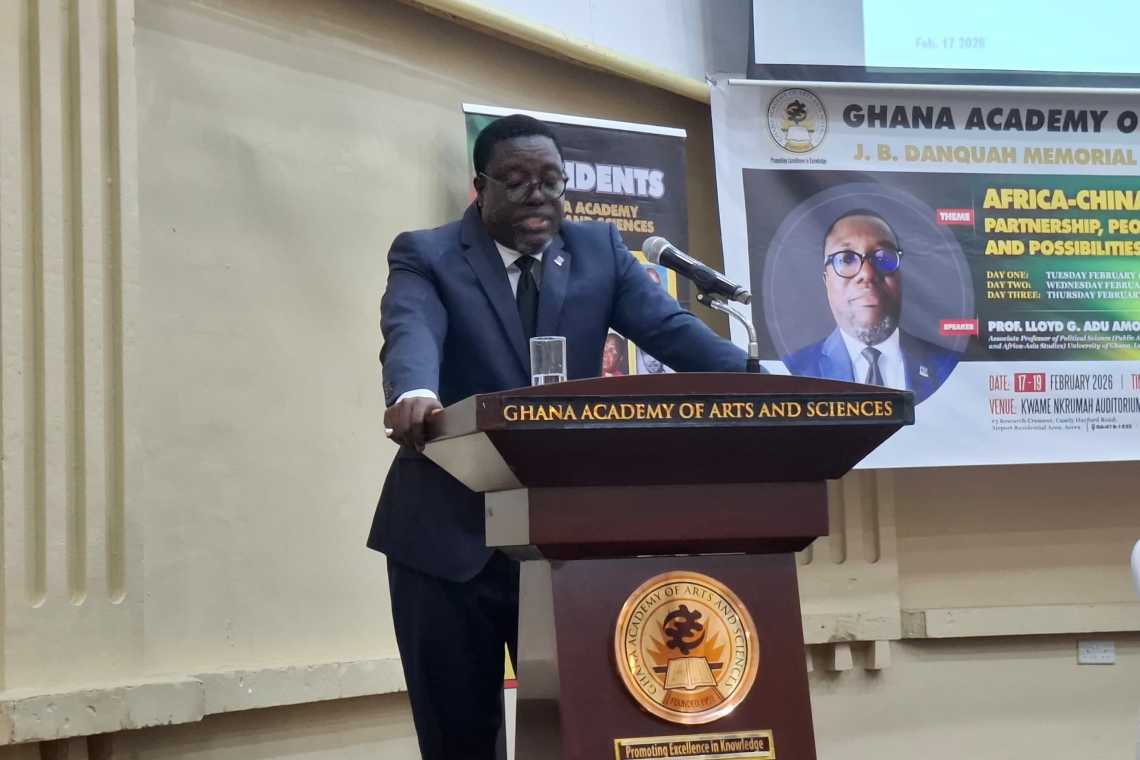
In a provocative and intellectually charged second installment of the 2026 J.B. Danquah Memorial Lectures, Professor Lloyd G. Adu Amoah has issued a stark warning to African
nations: the continent is currently undergoing a "digital conquest" by global superpowers, with China leading the charge.
Delivering his lecture at the Ghana Academy of Arts and Sciences (GAAS), Prof. Amoah argued that Africa’s heavy reliance on foreign technology has turned the continent into a "pawn" in a new era of Digital Imperialism.
1. What is "Digital Imperialism"?
Prof. Amoah coined the term to describe a modern form of empire-building facilitated not by physical territory, but by the control of Internet and telecommunications infrastructure.
"In a digital imperialism age, Africa is simply a consumer of digital technologies... [China] powers its way towards global digital supremacy." — Prof. Lloyd G. Adu Amoah
The Anatomy of the "Digital Stack"
Amoah warned that power in the coming decades will be defined by who controls the "stack"—the layered infrastructure that allows digital life to exist. This includes:
-
Hardware: Submarine cables and 4G/5G base stations.
-
Platforms: Cloud computing and data centers.
-
Proprietary Rights: The patents and software code that dominate distribution and consumption.
2. The China Factor: Dominance by the Numbers
The Professor presented data showing an "increasingly one-sided dependence" on Chinese technology giants, specifically citing Huawei’s structural grip on African connectivity.
Because China controls the hardware, data centers, and cables, Prof. Amoah argued that Beijing effectively possesses the "power to stop the digital life of Africa if it so chooses."
3. The "Diplomacy of Architecture"
Moving beyond the digital realm, the lecture touched on a physical manifestation of soft power: the construction of landmark public buildings across Africa by Chinese firms.
Amoah questioned the lack of reciprocity in these relations, famously asking: "What has Africa built in China? Not even a statue." This "Diplomacy of Architecture" serves as a permanent, visible reminder of external influence, which he contrasted with Africa’s inability to project its own culture or technology back into the Chinese heartland.
4. The "Pawnage" Risk
The week-long series, themed “Africa-China Relations: Partnership, Peonage, Pawnage, and Possibilities?”, seeks to deconstruct the "partnership" narrative.
-
The Fear: That Africa is a "pawn" being used to fuel China's rise to superpower status without gaining the industrial or technological base to stand on its own.
-
The Solution: A call for African "Agency"—where the continent stops being a mere consumer and starts owning the intellectual property and infrastructure that powers its future.
The Bottom Line
Prof. Amoah’s lecture serves as a "reset" for the intellectual discourse on Africa-China relations. By highlighting that Africa’s "digital heart" is beating in a chest controlled by foreign powers, he challenges the next generation of African leaders to reclaim their digital sovereignty before the conquest is finalized.