
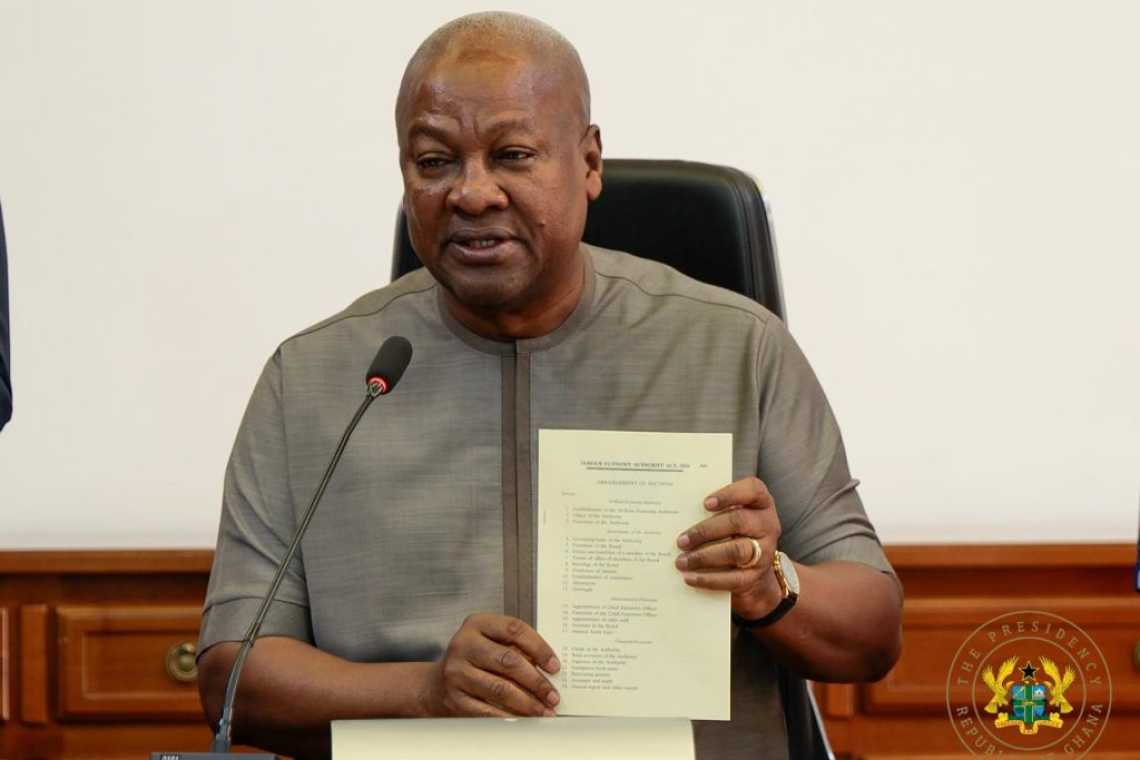
The legislative path for Ghana’s most ambitious economic reform is now complete. Earlier today, President John Dramani Mahama officially signed the 24-Hour Economy Authority
Bill into law.
The assent marks a decisive shift for the administration, moving from the conceptual "Reset" phase to a legally-backed execution stage. The new Authority will act as a central coordinating hub, overseeing a policy designed to transform Ghana into an export-led, round-the-clock economy.
1. The Three Pillars of the 24-Hour Authority
The new legislation isn't just about longer hours; it provides a structural framework built on three critical pillars designed to fix the "deformities" of the current economic model.
-
Pillar 1: Production Systems Development & Transformation
-
Focuses on moving from raw material exports to high-value manufacturing and agro-processing.
-
-
Pillar 2: Supply Chain & Market Systems Development
-
Ensures that goods produced at 2:00 AM have a seamless "path to market," including optimized logistics and digital marketplaces.
-
-
Pillar 3: Labour Development
-
Targets the creation of a "three-shift" system, aimed at generating approximately 1.7 million quality jobs over the next four years.
-
2. What’s in the "Incentive Package"?
The President noted that the business community is eager to see the "concrete steps" the government will take. Based on the 2026 budget and policy documents, participating firms can expect a performance-based regime:
3. The Coordinating Secretariat
The Authority will replace the interim 24-Hour Economy Secretariat. Presidential Advisor Mr. Goosie Tanoh, who led the technical team, emphasized that the Authority will function as a Coordinating Secretariat. It will work across various ministries (Trade, Energy, Interior, and Transport) to ensure that when a factory decides to run a third shift, the streetlights are on, the police are patrolling, and the ports are open to receive their goods.
"We must move from strategy to implementation. The business sector is waiting... they want to see the package of incentives that we can afford." — President John Dramani Mahama
4. Addressing the Critics
While the Majority in Parliament hails the Bill as a "job-creation engine," the Minority has raised concerns about potential bureaucracy and the duplication of roles with existing agencies like the Ghana Export Promotion Authority (GEPA). However, the government maintains that a single, statutory Authority is necessary to break down the "silo" mentality of traditional ministries and provide a "one-stop shop" for 24-hour investors.
The Bottom Line
With the President’s signature, the 24-Hour Economy is no longer just a campaign promise—it is the law of the land. For Ghanaian youth and entrepreneurs, the next few months will be telling as the first wave of "24-Hour Incentives" is rolled out to the private sector.