
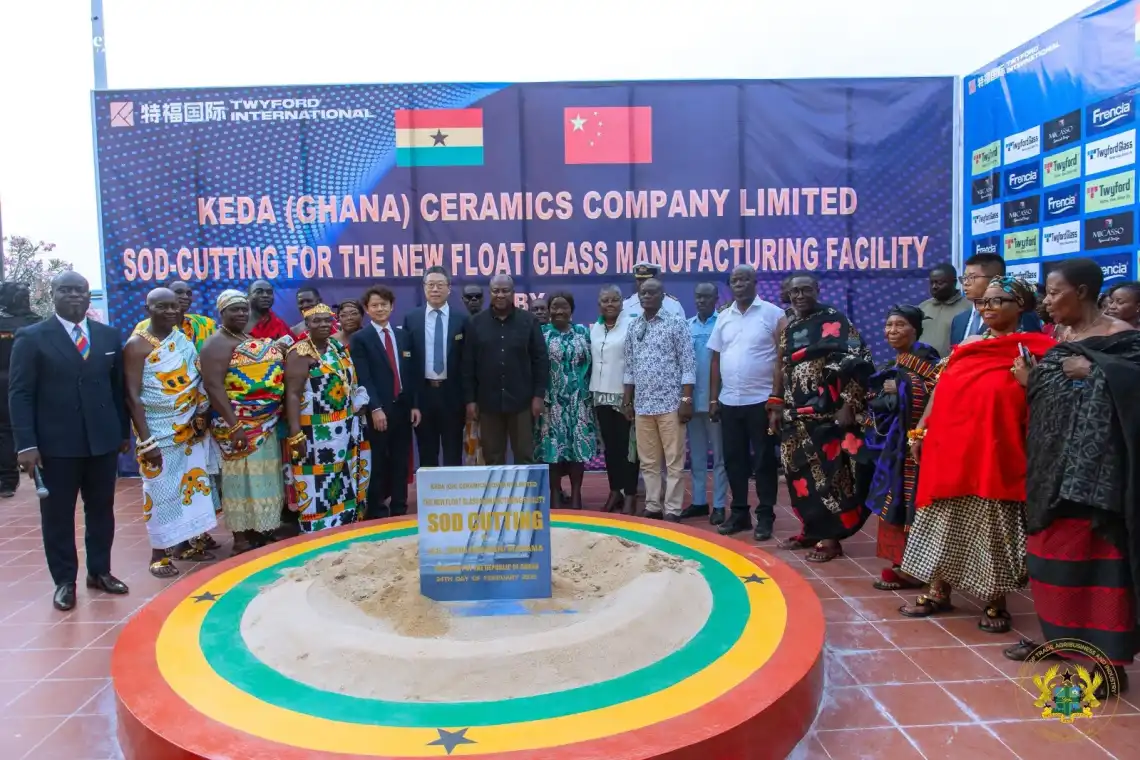
In a move that signals Ghana’s shift from a consumer-led economy to a manufacturing powerhouse, President John Dramani Mahama has officially cut the sod for a $250 million
float glass manufacturing facility at Aboadze, in the Shama District of the Western Region.
The project, a collaboration with the Twyford Group and KEDA Ghana Ceramics Ltd, represents one of the largest industrial investments in the nation’s history. It is specifically designed to leverage the newly enacted 24-Hour Economy Law to ensure continuous production and global competitiveness.
1. Production Capacity: Scaling to 1,400 Tons Per Day
The facility will be rolled out in two strategic phases to ensure a steady increase in output and market penetration.
President Mahama noted that with the global float glass market valued at $60 billion annually, Ghana can no longer afford to remain on the margins. This facility aims to turn the country from a net importer of glass into a major exporter.
2. The "Employment Engine": 6,000 New Jobs
The project is set to become a massive source of livelihood for the Western Region and beyond, utilizing the 24-Hour Economy model to maximize labor productivity.
-
Construction Phase: 2,182 jobs will be created during the building process, with 729 specialized roles in factory assembly.
-
Permanent Operations: Once complete, the facility will provide 1,453 permanent roles.
-
Total Impact: When factoring in supply chains and logistics, the project is expected to support nearly 6,000 direct and indirect jobs.
3. Strategic Alignment with the 24-Hour Economy
Mr. Shen Yanchang, Chairman of the Twyford Group, praised the government’s macroeconomic stability and the legislative support of the 24-Hour Economy Authority.
Why the 24-Hour Model is Critical for Glass:
-
Continuous Heat: Glass manufacturing requires furnaces to stay at high temperatures 24/7; the 24-hour law provides the shift-based incentives and off-peak tariffs needed to make this profitable.
-
Efficiency: Continuous production cycles reduce the waste associated with stopping and restarting machinery.
-
Competitiveness: Increased output allows "Made in Ghana" glass to be priced competitively within the AfCFTA market.
4. Bridging the Production Gap
Mr. Lorry Li-Wei, Managing Director of KEDA Ghana Ceramics Ltd, emphasized that the factory is designed to solve the "significant gap" in local glass production. Currently, Ghana spends millions of dollars in foreign exchange to import architectural and automotive glass. This facility will localize that value chain, saving the nation vital foreign reserves.
"We are no longer content to be a consumer and importer economy. We are determined to produce, process, manufacture, and export." — President John Dramani Mahama
The Bottom Line
The Aboadze Float Glass Factory is more than just a factory; it is a $250 million vote of confidence in Ghana’s industrial "Reset." By August next year, the first sheets of glass will begin rolling off the line, signaling a clear end to the era of total import dependency for construction materials.