
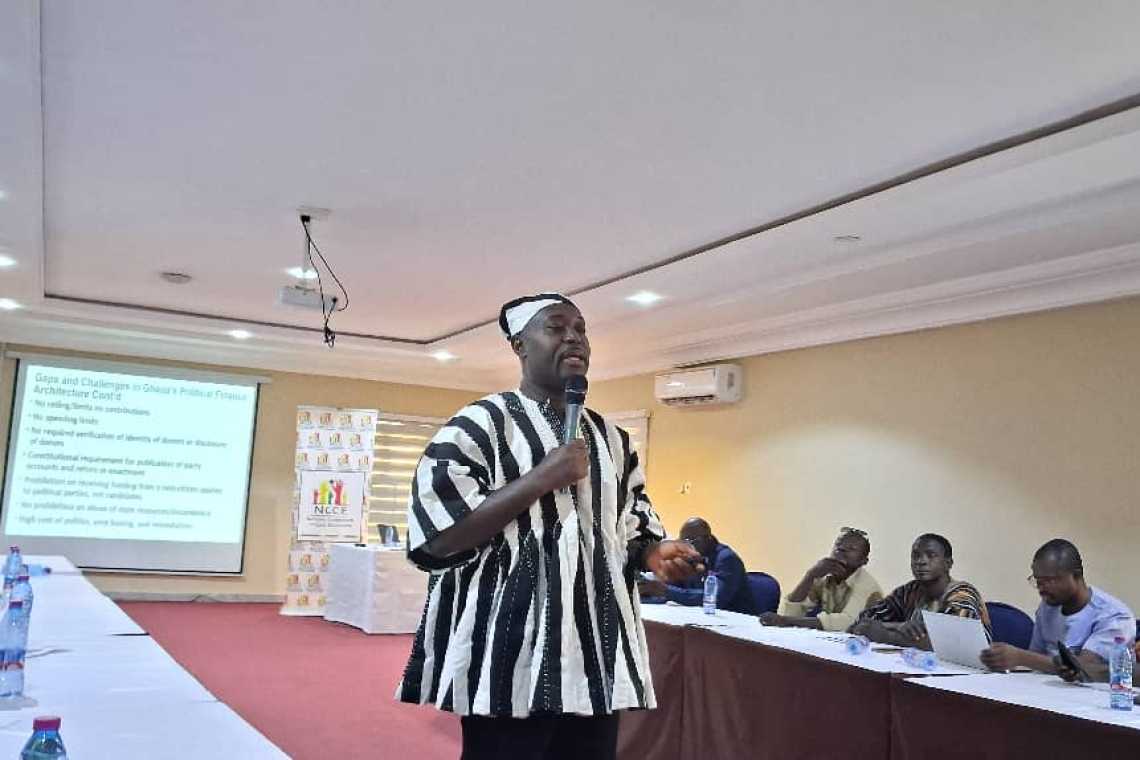
In a stinging critique of Ghana’s current electoral oversight, Mr. William Nyarko, Executive Director of the Africa Centre for International Law and Accountability (ACILA), has
called for a radical "Reset" of the nation’s political financing laws. Speaking at a high-level governance forum in Bolgatanga, Nyarko argued that the Electoral Commission (EC) is no longer fit for the purpose of regulating party finances and called for the creation of an independent, specialized body to take over the mantle.
Nyarko described unregulated political funding as the "underbelly of grand corruption," warning that the current system allows illicit money to be "laundered" through political campaigns, only to be repaid through inflated state contracts once candidates take office.
1. Why the EC is "Less Than Satisfactory"
While the EC is mandated to manage elections, Nyarko pointed out that its capacity to audit and enforce political finance laws has been consistently weak. He advocated for a model similar to Kenya, where an independent institution is dedicated solely to party registration and financial compliance.
-
The Conflict: The EC is often bogged down by the logistics of national elections, leaving financial oversight to fall through the cracks.
-
The Solution: A new, well-resourced body with the "teeth" to impose sanctions on parties and individual candidates who fail to disclose funding.
2. The "90% Loophole": Targeting Individual Candidates
Perhaps the most alarming statistic shared by Mr. Nyarko is that 90% of all political contributions in Ghana go directly to individual candidates, rather than party offices.
Under the current Political Parties Act, these individuals are under no legal obligation to report their sources of wealth. Nyarko argues that this lack of accountability makes it impossible to track the influence of "political financiers" who may have ties to organized crime or foreign interests.
3. The 120-Day "Campaign Reset"
To stop the "permanent campaign cycle" that drains the finances of even the most well-meaning politicians, ACILA is backing the Constitutional Review Committee’s recommendation to legally define the campaign period.
| Current Reality | Proposed Reform (ACILA/CRC) |
| Campaign Period | Indefinite (often starts 4 years before election). |
| Spending Limits | None. |
| Disclosure | Parties only (often incomplete). |
| Primary System | Small delegate "pay-to-play" system. |
4. Ending the "Delegate Bazaar"
Nyarko further advocated for the criminalization of vote-buying specifically within intra-party primaries. He argued that the current "delegate system"—where a small group of people decides the fate of an aspirant—makes it too easy for wealthy candidates to "buy" the candidacy. Moving to a universal suffrage system for all party members in good standing would make such inducements prohibitively expensive and logistically impossible.
"We have seen the EC's performance... it has been less than satisfactory due to capacity constraints. Establishing a new, independent body will strengthen enforcement and safeguard our democratic future." — Mr. William Nyarko, ACILA
The Bottom Line
The Bolgatanga forum, organized by CDD-Ghana and the NCCE, has set the stage for a major legislative battle. As the 2026 political season heats up, the push for a Model Political Finance Law represents a critical attempt to ensure that the "Ghanaian Story" isn't sold to the highest bidder.